

In a recent announcement, Labour unveiled three new campaign promises directed squarely at small businesses. While all three are well worth exploring, there’s one in particular that we feel could have a real positive impact for sole traders: raising the GST threshold.
If you’re new here, we’ve been advocating for the GST threshold to be raised for the past few years. According to our research (and direct feedback from our users), the current $60k threshold is a heavy compliance burden for sole traders who are struggling to grow their businesses – particularly in the retail space. Increasing the threshold to $80,000, in our view, is a solid first step.
But what is the GST threshold, and how does it work? Why do we support raising the threshold? And how likely is it that this campaign promise will come into effect?
Let’s dig in.

What is the GST threshold?
Very simply, the GST threshold is the level of turnover at which businesses are required to register for GST.
💡 Turnover, also known as sales revenue, is the total amount you earn from selling goods and/or services, before expenses are deducted.
A business is required to register for GST when it earns, or expects to earn, $60k or more in turnover in any given 12-month period. This means adding an additional 15% GST charge to their prices, collecting it from customers and clients, and forwarding it on to Inland Revenue.
The important thing to note is that GST is a tax levied on clients/customers, not the business itself. But for the end consumer, it’s still essentially a 15% bump in costs. Sole traders in competitive industries can struggle to manage this price increase, and sometimes choose to absorb the cost themselves, negatively impacting their own cash flow.
“Once you hit $60,000, you have to earn a lot more quickly to avoid a pay cut, unless you think your clients can afford a 15 percent increase,” says Carl Rein, a personal trainer and Hnry customer.
The GST threshold vs fiscal drag
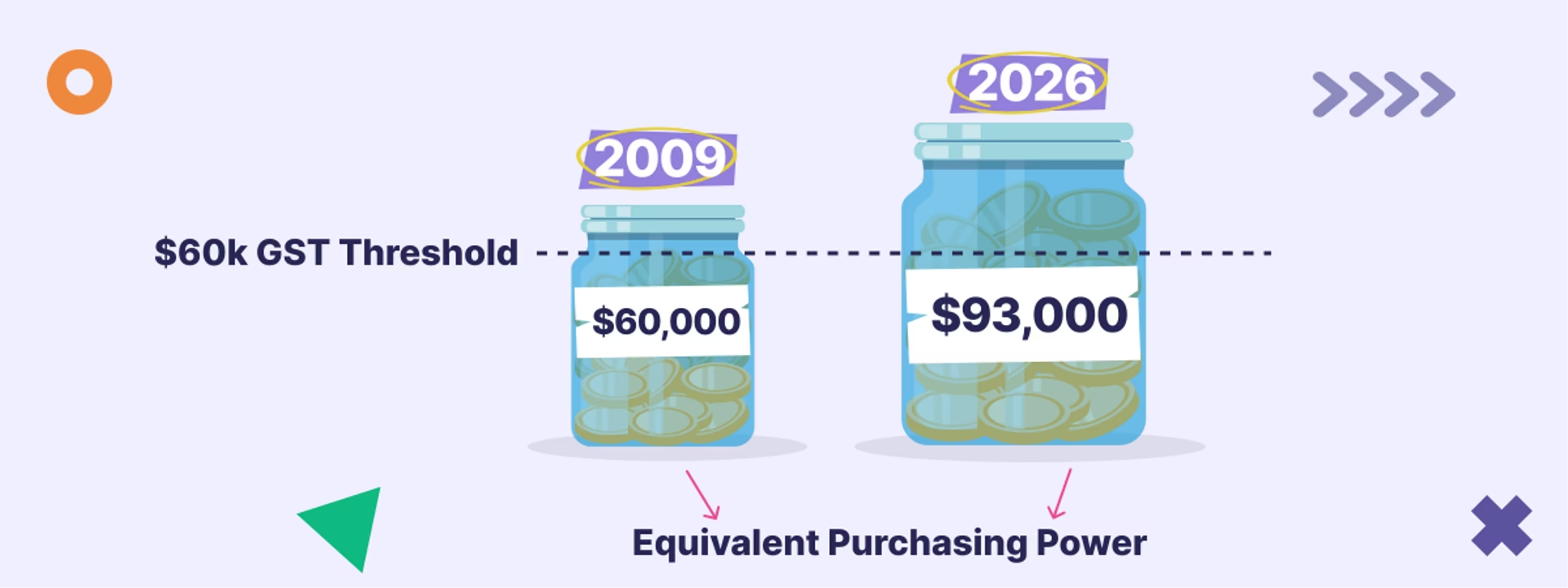
The current GST threshold was set in 2009, when it was increased from $40,000. It hasn’t been adjusted since. This means that due to fiscal drag, the GST threshold essentially kicks in at a far lower level than it was originally designed to do.
Let us explain: fiscal drag happens when costs rise due to inflation, and earnings increase to keep pace – but tax thresholds don’t.
What this means is that even if your purchasing power remains the same, the threshold at which you owe tax gets lower in real terms.
$60,000 in 2009 is worth around $93,000 in 2026. If the GST threshold had been raised in line with inflation, that’s where it would sit today. Instead, the GST threshold is still set at $60,000, which is the equivalent of around $39,000 in 2009 – not the original intention.
Why the threshold no longer works for sole traders
That brings us back to the current situation, where sole traders earning above that $60k threshold are required to register for GST. For some sole traders, it’s not much of an issue – contractors and freelancers, for example, tend to work for other GST-registered businesses and companies who can claim back any GST they pay in their own GST returns.
But for retail sole traders who provide goods and services directly to consumers, a 15% increase in prices can be difficult to manage. The cost of living is tight, discretionary spending is down for many households, and charging more means being less competitive.
To get around this problem, some sole traders absorb the cost of GST themselves, paying the sales tax out of their own pocket. Others suppress their earning potential to stay below the threshold, avoiding the registration requirement altogether.
“Increasing my rates by 15% would impact my earnings, because people have less to spend on wellness, particularly in Wellington,” says Carl. “At the moment, it’s just not worth it, so I have to manage my workload to stay under.”
Labour’s proposal: raising the GST threshold
As part of Labour’s recently announced Small Business Action Plan, they pledged to raise the GST threshold from $60,000 to $80,000. If elected, this will go into effect from 1 July 2028.
According to their estimate, raising the threshold would give approximately 35,000 small businesses the opportunity to earn more before the increased compliance requirements of GST.
“Every haircut that doesn’t happen, every personal training session that isn’t booked and every home that isn’t cleaned because of where the threshold sits is economic activity New Zealand misses out on,” says James Fuller, CEO and Co-Founder of Hnry.
“This policy would give thousands of consumer-facing sole traders more room to grow, earn and serve their customers without hitting an outdated tax cliff.”
Some critics of the proposal feel that raising the threshold is “shifting” the problem – for example, sole traders would stop trading before an $80k threshold the way they currently do with $60k.
But this perspective ignores the original purpose of the threshold: to keep compliance costs low for smaller businesses. Raising the threshold to $80k isn’t arbitrarily moving the goalposts; it’s partially restoring the real value that the $60k threshold had when it was set.
Our data shows that sole traders want to earn more, but are constrained within a system that no longer works for them. Based on this research, the optimal GST threshold is around $85,000, within a recommended range of $80,000 to $90,000. This would clear the way for consumer-facing sole traders to earn more without stalling.
What needs to happen for the GST threshold to be raised?
As it currently stands, a few things!
Firstly, Labour would have to win the next election (election day is 7 November 2026). Unless they win enough seats to govern alone, they’d also need to negotiate with potential coalition or support partners – which could affect whether the GST proposal makes it into the incoming government’s policy programme. They would then have to draft legislation and pass it through Parliament, in order for the new GST threshold to become law.
But that might not be the only path forward – other parties could choose to adopt this or a similar policy as part of their platform. Although there’s been no indication of this yet, there’s still time for big announcements in the run-up to the election.
For now, nothing has changed: the GST registration threshold remains $60,000. Sole traders still need to follow the existing GST registration rules.
But the more attention this issue gets, the better the chances a future government considers passing it into law. Until that happens, we here at Hnry will not stop advocating for it.


About Hnry
Hnry is an award-winning accounting service specifically designed for sole traders. For just 1% +GST of your self-employed income, capped at $1,500 +GST a year, Hnry will calculate and pay all your taxes, levies, and whatnot for you, including:
We’re also proud advocates for the sole trader community, who haven’t always had representation in the New Zealand economy. Our sole trader pulse is the first national research that solely (mind the pun) focuses on the opinions of sole traders, who have different needs to the small businesses they’re often lumped in with. Reconsidering the GST threshold is just one of the many things we’re pushing for.
Join the Hnry community, and never think about tax again.