
If you’ve ever thought about starting your own business, you’ve probably come across the term “sole trader”. But what does it actually mean?
Well for starters, as a sole trader, you are your business. Unlike limited liability companies, where the business is a separate legal entity, sole traders and their businesses are one and the same. This often makes it easier to get up and running, and simplifies tax and financial admin (depending on your circumstances – but more on this later!).
Sole traders are also the only owners of their business. There are no partners and no company directors sharing the driving seat – you’re completely in charge! Being a sole trader gives you complete control over the direction and day-to-day decisions of your business.
That said, the word “sole” only refers to ownership. You can still hire employees or engage contractors to work for you – even though many sole traders like flying solo, perhaps with only a loyal dog or a particularly attentive houseplant for company (we see you!).
Sole trader businesses can be found across a wide range of industries, income levels, and stages of life. From side hustlers moonlighting after their 9 to 5, to full-time professionals chasing their passion, the sole trader structure is a popular way Kiwi do business.
Whew! Let’s take a closer look:
- Common sole trader work types
- Why use a sole trader business structure?
- Getting started as a sole trader
- Sole trader taxes
- Hnry supports sole traders

Common sole trader work types
Sole traders can be found in almost every industry across Aotearoa.
In some cases, the type of work naturally lends itself to operating as a sole trader. In others, it’s simply a personal choice based on flexibility, lifestyle, or how someone wants to run their business.
While some industries are more commonly associated with sole traders, there’s no rule that says a particular kind of work must be structured this way. Many people start out as sole traders and later move into a different business or employment structure as their situation changes (for example, if they want to take on a partner).
Here are some of the most common sole trader work types and profiles (plus a couple you might not expect!):
Tradies
Tradies are one of the most well-known examples of sole traders. Electricians, plumbers, carpenters, landscapers, and painters often operate as sole traders, either working alone or with the help of apprentices and sub-contractors. Picture Pete the Plumber, zipping between jobs in his trusty van – master of his own schedule, choosing which jobs to take (and which late-night public toilet emergencies to politely avoid).
For tradies, being a sole trader allows for straightforward setup, direct control over jobs and pricing, and simpler tax requirements when compared to operating through a company (more on that later).
Contractors
Contractors frequently work as sole traders, especially in industries like IT, engineering, mining, transport, and consulting. Unlike employees, contractors are less likely to be employed by a single company for long stretches of time – instead, they can provide services to multiple clients under contract.
An IT contractor, for example, could be setting up networks for a corporate office one week, then troubleshooting Wi-Fi for a small, local café the next. Operating as a sole trader gives contractors flexibility over who they work with and how they structure their work, while still keeping business admin relatively simple.
Freelancers
Freelancers are a classic example of sole traders. They include designers, writers, marketers, photographers, videographers, developers, and creatives of all kinds. Freelance work tends to be more project or campaign based, although this isn’t always the case.
You might moonlight as a graphic designer, taking on logo commissions outside of your full-time investment banking job. Or maybe you’re a copywriter who writes newsletters for a vegan chocolate company in the morning, and travel blogs for yoga retreats in the afternoon – all from the comfort of your couch (BYO oatmilk latte optional).
Because of the flexible/project-based nature of freelance work, the sole trader business structure is often a great fit!
Health and wellness professionals
Sole trader health and wellness professionals can include:
- Personal trainers,
- Yoga and pilates instructors,
- Massage therapists,
- Nutrition coaches,
- Psychotherapists,
- Chiropractors,
- Locum doctors, nurses, and midwives,
- Occupational health consultants,
- … and more!
These businesses are often built around personal expertise and one-to-one services, making sole trading a practical and flexible option.
Retail and online sellers
Sole traders aren’t limited to service-based work. Many people running small retail businesses operate as sole traders, including those selling products through online platforms like Amazon, Etsy, eBay, or their own website.
Maybe you started selling homemade candles as a weekend hobby. Now, thanks to a viral TikTok video, you’re shipping custom scents around the country from your dining room table. Brilliant!
The sole trader business model works whether you’re running your side hustle alongside a day job, or operating full-time as an online seller, managing stock, orders, and customer service.

Why use a sole trader business structure?
We’ve covered some of the more common sole trader work types – but outside the work itself, what are some of the pros of being a sole trader?
Great question!
It’s easier to get up and running
One of the biggest advantages of being a sole trader is simplicity. Compared to running a company, there’s generally far less paperwork and administration, especially to get started (more on this in a bit!).
You also don’t file a separate tax return for your business and then another one for yourself. Instead, your business income and expenses are included in your individual tax return, making reporting and compliance more straightforward.
(https://hnry.co.nz)
This simplicity is a big reason why many people choose the sole trader structure, especially when just starting out. Less admin means more time for actual work (or those important after-work hobbies).
Your admin is simpler overall
Like we said earlier, a sole trader is not an incorporated company. This means you don’t operate as a Ltd – instead, you and your business are legally the same entity.
Practically, this means the money your business earns is your money. There’s no massive faff required to withdraw money from your business – your business’ money is your money. Easy!
This does mean you’ll need to budget accordingly, to make sure you’re able to reach your personal and business goals. But it also means that your finances are much simpler – you don’t even need separate bank accounts for you and your business (although you can have separate accounts if you like!).
Speaking of being one with your business –
You can manage risk with insurance
This “no separation” thing can sound daunting at first, especially when it comes to liability. Because you are the business, you are personally responsible for anything that happens. But don’t fret – this is exactly why insurance policies exist.
Like with any well-run business, a good insurance policy can make sure you’re covered in case anything goes wrong (we know you’re good at what you do, but unfortunately, accidents do happen!).
📖 We have a whole guide to insurance specifically for sole traders, because you really do deserve peace of mind on the job!
Room to grow
Finally, being a sole trader doesn’t mean staying small. You can absolutely grow your income, expand your client base, and hire employees as your business develops.
Staying a sole trader is a valid way to continue to operate, if that works for you (and it does for many people – there are around 400,000 sole traders in New Zealand!).
But if your situation changes – say you want to take on a partner, or raise capital – you can always incorporate a company down the line. Starting as a sole trader gives you a flexible, low-cost, simple way to start and build your business, with options available depending on where you go in the future.
Getting started as a sole trader
Setting yourself up as a sole trader in Aotearoa is refreshingly straightforward – whew!
All you really need to do to get started is start trading. Congrats! You’re a sole trader!
There are, however, a few bits and pieces you may need to consider:
1. Apply for an NZBN (optional)
Getting an NZBN is not mandatory, but it can make your business more visible, save you time, and enhance your credibility. Some overseas clients may prefer it if you have one.
Reasons to register for an NZBN:
- Visibility: Having an NZBN means your business’s details are searchable in the NZBN register. This makes it easier for customers and suppliers to find you. It can also make it easier for you to do business with government agencies, as they may require an NZBN to register for certain services.
- Saves time: You can also use your NZBN to automatically pre-populate forms and applications with your business details.
- Enhances credibility: Having an NZBN can make your business appear more professional and established. This can help build trust with potential customers, suppliers, and other stakeholders.
- It’s free and easy to register: Registering for an NZBN is free and easy to do online through the NZBN website. All you need are your business details and a form of identification such as your driver’s license or passport.
2. Register for GST (if required)
If you make $60,000 or more in business income any given 12-month period, you’re required to register for GST.
This means charging GST on your products and services, collecting it from your clients, filingregular GST returns, and reporting and paying any GST owed to the IRD.
If you make less than $60,000, GST registration isn’t mandatory.
3. Start trading
Honestly, you could have just started here. Becoming a sole trader in Aotearoa is one of the easiest ways to start a business – in many cases, all you need to do is start trading.
Compared to incorporating a company, there are way fewer steps, lower startup costs, and less ongoing admin. Tada!

Sole trader taxes (because of course)
Tax is an unavoidable part of running a business, but for sole traders, it’s generally simpler than for other business structures – woo!
Income tax
Like we mentioned earlier, your business’ finances are your finances. Because of this, sole traders pay income tax at individual tax rates, not at the company tax rate.
In New Zealand, your income as an individual is taxed progressively, based on how much you earn in total for the financial year. As your income increases, different portions of it are taxed at higher rates.
📖 For a more in-depth explanation on how tax rates work, check out our guide to sole trader tax rates.
Because tax isn’t automatically withheld from your income like it is for employees, sole traders are responsible for sorting their own taxes. There’s nothing worse than the surprise of a big tax bill – except perhaps not setting money aside and meeting the IRD with nothing but a winning smile.
That’s actually where we come in – Hnry automatically calculates, deducts, and pays your tax for you throughout the year, every time you get paid. No surprise tax bills, no tax rate calculations, and no guesswork required!

Claiming business expenses
One of the most effective ways to reduce the amount of tax you owe is by claiming your business-related expenses.
Claiming business expenses reduces your taxable income (not your final tax bill!), which means you pay tax on a smaller amount overall. In very, very simple terms, the less taxable income you have, the less tax you pay.
To be an eligible expense, it generally needs to be directly related to earning your income. Common sole trader expenses can include things like tools and equipment, work-related travel, phone and internet costs, software subscriptions, professional fees, and a business-use portion of home office expenses if you work from home.
📖 The IRD can get quite specific about what they will and will not accept as a valid business expense. For more information, check out – you guessed it – our monster guide to claiming expenses for sole traders.
Keeping accurate records of your income and expenses throughout the year makes claiming them far easier. Plus, the IRD actually requires you to keep your receipts for seven years.
(https://hnry.co.nz)
ACC Levies
Sole traders are generally liable for three separate ACC levies. Each levy is calculated slightly differently, with rates updated every April. As of April 2025:
- the Earner’s levy is a flat rate of $1.67 per $100 of your liable income
- this helps fund cover for injuries that happen during everyday, non-work activities
- the Working Safer levy is a flat rate of $0.08 per $100 of your liable income
- this helps fund WorkSafe NZ, New Zealand’s primary workplace health and safety regulator
- the Work levy is based on the industry you operate in
- this helps fund cover for injuries that happen at work
- the riskier your line of work, the higher this levy will be
💡 To calculate the Work levy, you’ll need to find your Classification Unit, and then look up the corresponding levy rate in ACC’s levy guidebook. See our ACC guide for more info.
To make things slightly more complicated, ACC levies are calculated using your liable income – that is income between the minimum and maximum thresholds as set by the ACC. These tend to change every financial year, so it’s something you’ll need to stay on top of.
(https://hnry.co.nz)
The good news is that having a maximum threshold for liable income means there’s an upper limit on how much Earner’s levy you’ll pay in a year.
📖 For more information on the three levies and how they’re calculated, check out our sole trader guide to the ACC.
GST (if applicable)
The Goods and Services Tax (GST) is a consumption tax that’s charged on most goods and services in Aotearoa. It’s a flat 15% charge on top of the regular price of a product or service you buy (if that seller is registered for GST). The good news is that you can claim back GST on your business-related expenses.
Like we mentioned earlier, if you’re registered for GST as a sole trader, you’ll need to charge GST on your products and services, and forward it to the IRD. This is done through GST returns, which you’ll need to complete and file regularly.
Remember, GST isn’t your money, even though it passes through your bank account. You’re simply collecting it on behalf of the IRD, which is why it’s important to track it separately and be prepared to pay it when it’s due.
If you’ve paid more GST than you’ve collected, you may be eligible for a GST refund – maybe that calls for a celebratory coffee (and, dare we say, a sweet treat).
📖 For more information, see our whopper guide to GST and how it works. You get a guide! You get a guide! Everybody gets a guide!
(https://hnry.co.nz)
Student loan repayments
So it’s actually not a tax or a levy, but if you have any outstanding student loan debt, you’ll need to make compulsory repayments alongside all your other tax bits and bobs. Repayments are generally calculated at 12% of your income above the repayment threshold, currently set at $24,128. Tada!
Seriously though – and we can’t say this enough – Hnry will literally sort all this for you. We will calculate what you owe from your sole trader income, deduct it from your earnings, and forward it to the IRD when due. Easy, sorted, done.
Hnry supports sole traders
So there you have it – what a sole trader is, what kinds of work they do, how to run a sole trader business, and how to pay your taxes as a sole trader.
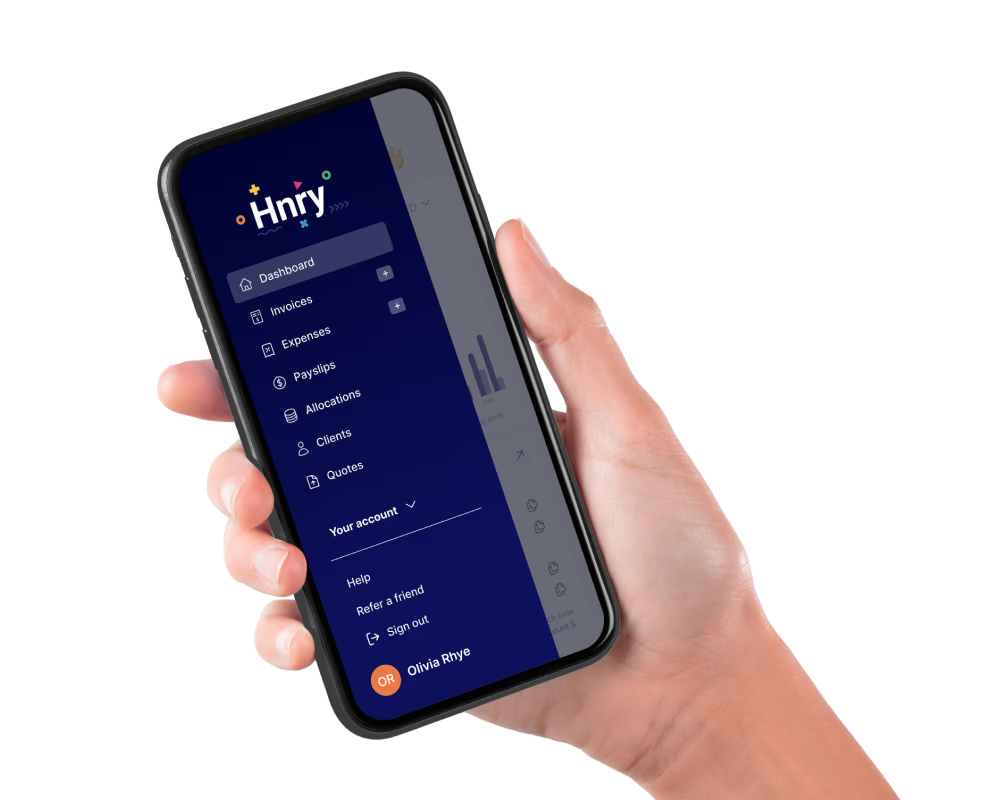
Except you really don’t need to know that last bit, because Hnry sorts it all for you. We’re an award-winning tax service and app, and we’re on a mission to make it simple and accessible for anyone to run a sole trader business.
For just 1% +GST of your self-employed income, capped at $1,500 +GST a year, we’ll automatically calculate, deduct, and pay your:
- Income tax
- GST payments (if applicable)
- ACC levies
- Student loan repayments
- KiwiSaver contributions (optional)
… meaning everything that hits your bank account is yours to spend. We also file your GST and tax returns for you, whenever they’re due. It’s all part of the service! All you have to do is focus on the fun stuff – like the actual job.
You can also use the Hnry App for:
- Unlimited quotes and invoices
- Managing your business expenses
- Tracking your profit before tax
- Allocating funds for savings, investments, and more
Plus we regularly launch new features and products (like the Hnry Debit Card!) that make our user’s lives easier.
If this sounds good to you, what are you waiting for? Join Hnry, and never think about tax again.