

Launching a new product or service? Or perhaps you’re just getting into the sole trader game for the first time. Whatever the case, market testing can help ease your way to success. Understanding exactly where the demand is for your product can help you determine things like how to market and price it.
In this article, we’ll walk through what ‘product-market fit’ actually means (in non-MBA language), how you can measure it using simple, practical methods, and how to keep iterating and improving over time.
What is product-market fit?
Basically it’s a fancy way of saying: You’re selling something people genuinely want, to the right people, at the right price – and they’re happy enough to come back or tell others about it.
We know that what you’re selling is the greatest thing to exist in the history of the universe, obviously! But you may have to come to terms with the idea that it won’t be everyone’s cup of tea.
Your best bet for success is to make sure your product finds the right market – in other words, the right community of people who want or need your product or service. If you operate within a niche, this could be a small pond. Or if your wares are more generally applicable, this could be the whole ocean.
What you’re aiming for could include:
- Customers buying without needing convincing or heavy discounts
- Repeat business or referrals
- Clear patterns around who’s buying (for example: is it always new parents? Or mostly small construction firms?)
- You see that you’re solving a real problem, rather than trying to convince people to buy your product or service
To get to this point, you may need to conduct market testing (unless you’re lucky and nail sales as soon as you launch). Let’s take a look at some strategies you can implement.
How to test product-market fit
Market testing is everything you do to check whether your idea, product, or service resonates with real people. It’s about doing small experiments instead of taking big, risky bets.
For sole traders, this is especially important because your time and money are limited and you want to make the biggest splash you can. Sole traders have the advantage of being able to move fast and pivot quickly (no board meetings required!). Market testing helps you adjust early, so you can invest in the right things.
There are several ways to test whether you’ve hit product-market fit:
Pre-sales – are there many takers?
A pre-sale is when you ask people to commit and pay for your product or service before it’s fully available. You’re basically saying, “I’m offering this thing on [future date]. If you’re keen, you can secure your spot/purchase now.”
It’s one of the strongest tests of demand because people aren’t just saying “That sounds cool” or even that they will buy it – they’re supporting you right now.
Let’s say you’re a copywriter specialising in web copy for tradies. You could offer a Tradie Website Copy Launch Package at a special pre-sale price for the first five clients. If those first spots fill up quickly, you’ve learned there’s demand for that specific offer (and possibly that you could have charged even more!).
Or maybe you sell hand-painted, personalised journals and notebooks. Before you order a heap of materials and stock up on the product, you could put up a simple landing page or social post showing the designs and offer discounted pre-orders for the first 30 customers, delivered within four weeks. Again, if people are willing to pre-order and wait, it’s a strong sign you’re on to something!
Pre-sales help you test real demand, validate your pricing, and build your customer base while reducing your risk – if nobody bites, it could be time to rethink your strategy.
Because you’re taking people’s money in advance, pre-sales are basically a promise you must be able to keep. So:
- be realistic about your capacity,
- double-check you can deliver what you’ve sold on time (including any supplier lead times),
- make sure customers clearly understand what they’re getting, when they’ll get it, and
- what will happen if there are any delays.
Basically, make sure customer expectations line up with yours!

Limited releases
A limited release is when you offer your product or service to a small, controlled group first – often with limited quantity, features, or availability. Think of it as your beta test or soft launch.
Say you’re a fitness coach creating a new eight-week program for new mums. Instead of launching to everyone at once, you could:
- Open 10–15 spots only for a “founding round”
- Offer it at a lower price in exchange for honest feedback and testimonials – which can help you win more customers the next time you run it
- Run the program with this small group, paying close attention to what works and what doesn’t
- Tweak the structure, content, and support based on their feedback before offering it more broadly.
Or if you make handmade chocolate, you could:
- Create a one-off “Disaster Relief” limited edition chocolate box using special flavours or ingredients
- Make 150 boxes and price them slightly higher than your usual range
- Donate a portion of profits to a chosen charity and promote the limited run and cause
If you sell out, note that customers are keen to buy this again in future and that exclusive, time-limited drops resonate with your audience, so you can repeat this strategy with different products.
Similar to pre-sales, limited releases let you test your product or service in real conditions, but with manageable risk.
When you run a limited release, be clear on what you’re testing (price, packaging, process, or results), and choose testers who match your ideal customers rather than family and friends. Set expectations upfront by explaining that it’s a limited offer and part of a test phase, so they know they’re helping you shape the final version and may get a better price, more access to you, or extra bonuses in return.
Ask your network/audience
As well as pre-sales, limited releases, and launch sales, you can run simple surveys or polls to ask followers or existing clients what problems they’re struggling with, or which version of an offer they’d prefer.
You can test your pricing by offering slightly different price points or packages and see what people gravitate towards, as well as offering free or low-cost trials (with boundaries).
Prioritise what people do over what they say. If they’re saying nice things about your product or service but not buying or recommending it, you have an issue that needs addressing.
Remember, as a sole trader, you can move quickly! You don’t need a 50-page strategy document – you just need a hypothesis, a test, and a way to measure the outcome.

Ongoing strategy
It’s never really one-and-done in business. Even when you’ve found something that works, it never hurts to ask:
- Can my product or service be better?
- Can I create a new version of it to maximise sales?
- Can I adapt to changes in my market or my own capacity?
It’s important to regularly track your sales, figure out what’s working, double down on that, and pivot as necessary.
Let’s say you’re selling handmade soy candles and you notice your eucalyptus and lemon scent outsells the others three to one. On top of this, most orders are for medium-sized candles, and customers regularly buy around gift-giving seasons such as Christmas or Mother’s Day.
What you could do is create bundles focused on your best-selling scent, reduce or retire poor-performing scents or sizes, and lean into those gift seasons with special packaging, collaborations, deals, or limited releases. Product, meet market fit!
Pivot when things aren’t going to plan
If things aren’t going as well as you hoped, you can always pivot. One of the benefits of being a sole trader is you can make decisions unilaterally and try something new.
Some pivots might include:
Narrowing your target market: From ‘tradies who need a website’ to “Client-winning websites for plumbers in Wellington”. Show that you really understand your niche!
Tweaking your offer: From long 12-week programs that people struggle to commit to, to four-week intensives that are easier to say yes to.
Adjusting your format: From in-person only to online sessions, or from physical to digital products.
Repositioning your messaging: From ‘I write copy for tradie websites’ to ‘I help busy tradies get more jobs with website and Google Business Profile setups’.
A pivot doesn’t mean you failed – it means you learned something about what your customers really need, and adjusted accordingly. That’s smart business sense!
Respond to feedback
Your existing customers and clients are the best sources to help you with your market testing. With that in mind, you can always send short follow-up surveys after a project wraps up or an order ships.
Ask things like:
- Why did you choose me over other options?
- What nearly stopped you from buying?
- What else would you love to see from me?
Watch for recurring themes in the answers, as that’s gold for refining your offer.
Your numbers are also feedback: Once your market testing experiments start turning into real income, you’ll want to keep a close eye on which offerings generate the most revenue, which projects or products are most profitable after expenses, and how your income is tracking over weeks and months.
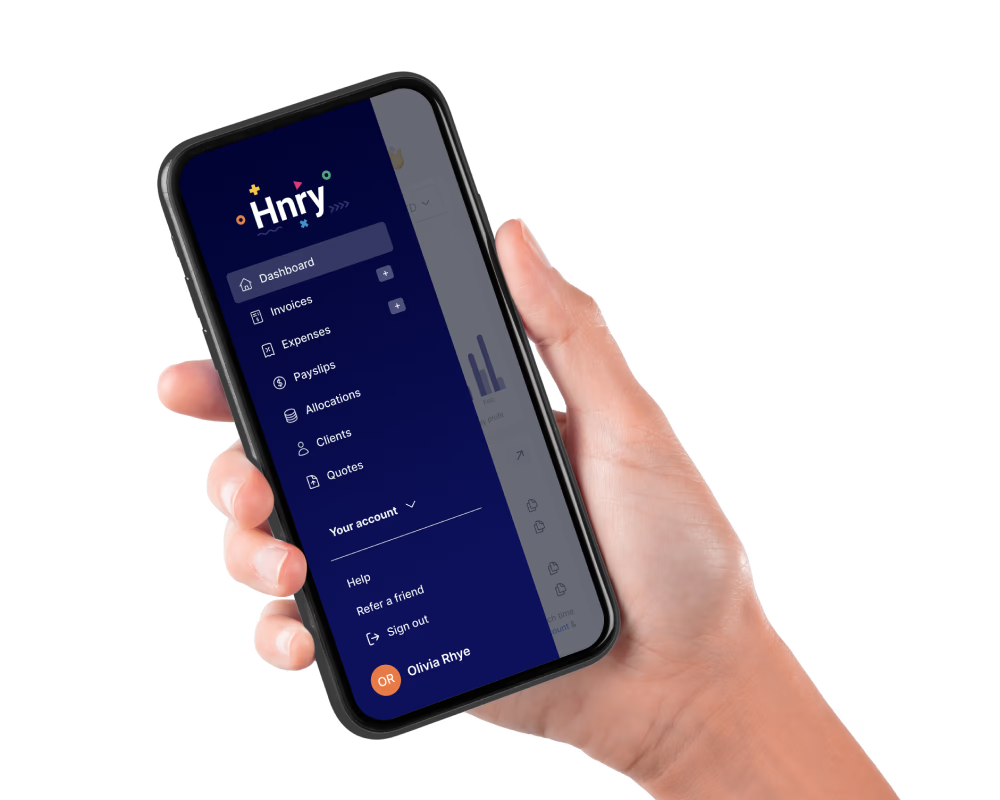
Hi, we’re Hnry
While you’re busy experimenting, refining, and delivering, Hnry can automatically calculate and pay your tax as you earn (whew!), set aside GST (if you’re registered), and help you keep your finances in order, even if you’re constantly tweaking your offers.
For just 1% + GST of your sole trader income, capped at $1,500 +GST a year, we calculate, deduct, and pay all your taxes, levies, and whatnot for you, including:
… meaning you won’t have to think about any of that. Ever.
All you need to do is focus on growing your business. We’ll be here in the background, making sure the tax stuff just works.